How Steam Regional Pricing Works
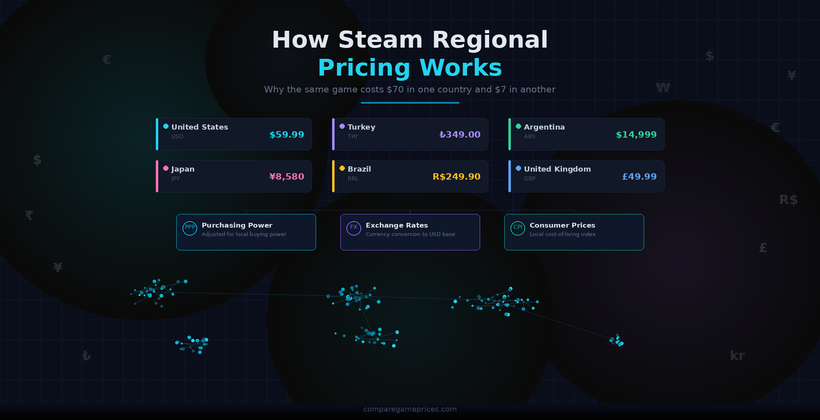
If you've ever checked the price of a game on Steam from different countries, you've probably noticed they're wildly different. A $70 game in the US might cost the equivalent of $46 in Ukraine or $8 in Pakistan. This isn't a bug — it's Steam's regional pricing system, and it's one of the most important (and misunderstood) features of the platform.
The Basics: What Is Regional Pricing?
Regional pricing means Steam charges different prices for the same game depending on where the buyer is located. Instead of converting a single US dollar price to every currency, Steam and its publishers set specific prices for each region that reflect local economic conditions.
The logic is simple: $60 means very different things in different economies. What feels like a normal purchase in the US or Western Europe could be an entire week's discretionary budget in countries like India, Ukraine, or Pakistan. Without regional pricing, most of the world would be priced out of buying games legally.
Steam's Pricing Regions
Steam operates dozens of distinct pricing regions, each with its own currency or regionalized USD pricing. We track 66 of them on CompareGamePrices. Here's how they break down:
| Region Group | Currency | Countries |
|---|---|---|
| Eurozone | EUR | Germany, France, Italy, Spain, Netherlands, Austria, Belgium, Finland, Ireland, Portugal, Greece, Slovakia, Slovenia, Estonia, Latvia, Lithuania, Croatia + more |
| Americas | USD / BRL / CAD / CLP / COP / CRC / MXN / PEN / UYU | US, Brazil, Canada, Chile, Colombia, Costa Rica, Mexico, Peru, Uruguay |
| Asia | CNY / INR / JPY / KRW / IDR / MYR / PHP / SGD / THB / TWD / VND / HKD | China, India, Japan, South Korea, Indonesia, Malaysia, Philippines, Singapore, Thailand, Taiwan, Vietnam, Hong Kong |
| CIS & Eastern Europe | UAH / KZT / PLN / EUR | Ukraine, Kazakhstan, Poland, Czech Republic, Romania, Hungary, Bulgaria |
| Middle East & Africa | AED / ILS / KWD / QAR / SAR / ZAR / USD | UAE, Israel, Kuwait, Qatar, Saudi Arabia, South Africa, Egypt, Nigeria, Turkey |
| Oceania & Nordics | AUD / NZD / GBP / CHF / NOK / SEK / DKK | Australia, New Zealand, UK, Switzerland, Norway, Sweden, Denmark, Iceland |
Some regions share the same currency but have different recommended pricing. Argentina and Turkey now use regionalized USD pricing (LATAM-USD and MENA-USD).
How Valve's Pricing Recommendations Work
When a publisher sets a USD price for their game, Steam automatically generates recommended prices for every other currency. These recommendations aren't just simple exchange rate conversions — Valve uses a combination of factors to calculate them:
- Exchange rates — the baseline conversion from USD to local currency.
- Purchasing power parity (PPP) — adjusts for how much everyday goods and services actually cost in each country, so prices reflect real affordability.
- Consumer price index (CPI) — factors in local inflation and cost of living data.
- Market conditions — considers piracy rates, local competition, and the size of the gaming market in each region.
This is why Valve's recommended price for a $60 USD game in India might be around ₹1,399 (~$16 USD) rather than the straight exchange rate equivalent of ₹5,040 (~$60). The recommendation reflects the economic reality that Indian gamers have significantly less purchasing power than American ones.
Publishers Have the Final Say
Here's where it gets interesting: Valve's recommendations are just suggestions. Publishers have full control over the final price in every region. They can accept Valve's recommendations for all currencies, override some, or ignore them entirely.
This creates three distinct pricing behaviors we see in the data:
- Indie developers tend to accept Steam's default recommendations for nearly every region. They usually don't have the resources or data to fine-tune pricing per country.
- Mid-size publishers often customize prices for key markets (Brazil, China, India) while accepting defaults elsewhere.
- AAA publishers frequently override recommendations with their own pricing strategy, sometimes resulting in smaller regional discounts than what Valve suggests.
This is exactly why there's no single "cheapest country" for all games — it depends on how each publisher chose to price their specific title. You can see this clearly when you compare prices across regions for different games.

What Happened to Argentina and Turkey
Until November 2023, Argentina and Turkey were the two cheapest regions on Steam by a huge margin. Games that cost $60 in the US could be under $5 in Argentina. Then Valve made a major change: both countries were switched from local currency pricing to USD.
The reason was extreme currency volatility. The Argentine peso and Turkish lira were losing value so rapidly that publishers couldn't keep prices updated, and the gap between regional prices had become so large that it created massive incentives for cross-region exploitation.
Valve's solution was to create two new USD-denominated pricing regions: LATAM-USD (covering Argentina and 24 other Latin American and Caribbean countries) and MENA-USD (covering Turkey and other Middle East/North Africa countries). These regions still get discounted prices compared to the US, but the discounts are much smaller than before — and critically, they're stable because they're pegged to the dollar.
Why Prices Still Vary So Much
Even with the Argentina/Turkey changes, the price gap between regions remains massive. Based on our data across 1,152 games, the average difference between the cheapest and most expensive region is about 67%. Several factors keep these gaps wide:
- Currency fluctuations — when a local currency weakens against the dollar (like the Ukrainian hryvnia or Pakistani rupee), prices in that country become cheaper in USD terms even if the local price hasn't changed. Publishers often don't update prices immediately.
- Stale pricing — some publishers set prices once and never update them. If exchange rates shift after launch, the regional price becomes increasingly out of sync.
- VAT differences — some regions include tax in the displayed price (most of Europe), others don't (the US). This can account for 5–25% of the apparent price difference.
- Different discount strategies — regional sales don't always happen at the same time or with the same percentage in every country.
How to Check Prices Across Regions
Instead of manually checking each region, you can use our price comparison tool to see what any game costs across the 66 regions we track at once. Everything is converted to a single currency so you can instantly see which region has the best price and how much you'd save.
We currently track over 1,150 games with prices updated regularly. For a data-driven breakdown of which countries are cheapest most often, check out our Cheapest Countries to Buy Steam Games in 2026 article.